
Year One · Read This First
THE PLAYBOOK
Never played before? Start at the top. Played for years? Skip to Part Two, because our settings are not the standard ones.
Never played before? Start at the top. Played for years? Skip to Part Two, because our settings are not the standard ones.
No jargon, no assumptions. If you have never played, this is everything you need before draft night.
You pick real NFL players. What those players do in real games on Sunday turns into points for you. Whoever scores more points that week beats their opponent. That is the entire game.
Before the season, all twelve of us take turns picking real NFL players from one shared pool. Once somebody is taken, he is gone. No two teams in the league can have the same player, so every pick matters to everybody else.
Our draft is 16 rounds, so everyone ends up with 16 players.
Only some of your players count. In our league 9 of your 16 start and the other 7 sit on the bench.
Bench players score nothing. If your best player is on your bench, those points are gone. Setting your lineup before games start is the single most important habit in fantasy football, and it is where new managers lose games they should have won.
Yards gained, touchdowns scored, passes caught. A running back who runs for 100 yards and a touchdown is a good day. A quarterback who throws four interceptions is not. Every league sets its own values, and ours are in Part Two.
Each week the schedule pairs you with one other manager. Add up your nine starters, add up theirs, higher number wins. That is one win or one loss in the standings.
You are not competing against everybody at once. You only have to beat the one person in front of you that week.
Players get hurt. Backups turn into stars. Anyone not on one of the twelve rosters is a free agent and you can add them, dropping somebody to make room. This is where good managers make up for a bad draft.
You can also trade with another manager, as long as you both agree.
The regular season runs most of the NFL year, then the top teams play a short bracket at the end. Win that and you are the first champion this league has ever had.
Every NFL team takes one week off during the season. If your quarterback's team is on bye and you leave him in your lineup, he scores zero. Sleeper warns you. Read the warning.
Nobody moves them out for you. A player ruled out on Sunday morning scores nothing if you left him starting. Check your lineup the morning of, not just on Wednesday.
It stings, everyone does it, and there is no rule that saves you. You get the nine you chose.
You cannot pick players up whenever you feel like it here. Bids resolve at 10 PM Eastern on Wednesday and Saturday, and those two moments are the only times all week that a roster changes. Miss them both and you wait. There is a whole section on this further down.
Our settings are not the default ones. Even if you have played for twenty years, read this part: two of our settings are unusual enough to be worth knowing.
This is what you put on the field every week. Nine slots, and each one only accepts certain positions.
| Slot | Accepts | How many |
|---|---|---|
| QB | Quarterback only | 1 |
| RB | Running back only | 2 |
| FLEX | Running back, wide receiver or tight end, but not a quarterback | 1 |
| W/T | Wide receiver or tight end | 3 |
| K | Kicker only | 1 |
| DEF | Team defense / special teams | 1 |
| BN | Anybody. Scores nothing. | 7 |
Because the flex can take a running back or a receiver, the most you can ever start is 3 running backs or 4 receivers, and the fewest is 2 and 3.
There is no single deadline for the whole lineup. Each player locks when his own game starts. Until then you can move him in or out as often as you like. After it he is frozen exactly where you left him, starting or benched, and nothing you do for the rest of that week changes it.
| His game | Usual start | Be set by |
|---|---|---|
| Thursday night | 8:15 PM ET | 8:14 PM Thursday |
| Sunday early | 1:00 PM ET | 12:59 PM Sunday |
| Sunday afternoon | 4:05 or 4:25 PM ET | one minute before |
| Sunday night | 8:20 PM ET | one minute before |
| Monday night | 8:15 PM ET | one minute before |
Most of any roster plays in the Sunday early window, so 12:59 PM Sunday is the one number worth remembering. It is not the whole answer though, and the Thursday game is the one that catches people: a player in it is gone two and a half days before the rest of the league locks. Sleeper shows every player's kickoff time next to his name, and that is the version that is always right.
Two things this does not mean. The lineup screen never closes, so it will always let you in; what changes is which players it will let you touch. At half past one on a Sunday the early-game players are greyed out while your afternoon and night players are still fully editable. And the bench is not frozen in our league. Anybody whose game has not kicked off can be swapped in, whether he started the week in your nine or on the bench. The only thing that blocks a move is one of the two players involved having already played.
These are our actual settings, pulled from the league. Three of them are unusual enough to be worth knowing before you draft.
| Stat | Points | |
|---|---|---|
| Passing yards | 0.04 | 1 point per 25 yards |
| Passing touchdown | 6 | higher than standard |
| Interception thrown | −1 | |
| Rushing yards | 0.1 | 1 point per 10 yards |
| Rushing touchdown | 6 | |
| Reception, any position | 0 | no PPR anywhere: the catch alone pays nothing |
| Receiving yards | 0.1 | 1 point per 10 yards |
| Receiving touchdown | 6 | |
| Two point conversion | 2 | |
| Fumble lost | 0 | no penalty in our league |
| Achievement | Extra | |
|---|---|---|
| 300 passing yards | +4 | in a single game |
| 400 passing yards | +6 | |
| 100 rushing yards | +5 | |
| 200 rushing yards | +10 | |
| 100 receiving yards | +4 | |
| 200 receiving yards | +7 | |
| Touchdown of 40+ yards | +4 | passing, rushing or receiving |
| Touchdown of 50+ yards | +6 | passing, rushing or receiving |
| Stat | Points | |
|---|---|---|
| Field goal, under 40 yards | 3 | |
| Field goal, 40–49 yards | 4 | |
| Field goal, 50–59 yards | 5 | |
| Field goal, 60+ yards | 7 | |
| Missed field goal | −1 | |
| Extra point | 1 | missed extra point −1 |
| Stat | Points | |
|---|---|---|
| Sack | 1 | |
| Interception | 1 | |
| Fumble recovered | 1 | forced fumble also 1 |
| Touchdown | 6 | defensive or special teams |
| Safety | 4 | |
| Blocked kick | 1 | |
| Shutout, 0 points allowed | 15 | |
| Allowed 1–6 points | 8 | |
| Allowed 7–13 points | 3 | |
| Allowed 14 or more | 0 | never goes negative in our league |
| Held under 100 total yards | +2 |
Our draft order was randomized on August 10 and it is locked. The draft is a snake, which is the part that confuses people the first time.
In pick order, first to last.
Then round three goes forwards again, and it keeps alternating for all 16 rounds.
This is what keeps it fair. Picking first is great in round one and terrible in round two. Picking last is the reverse: you pick 12th and 13th back to back, which is two good players in a row.
Every slot averages out. Do not worry about where you landed.
None of this is a rule, and none of it is a prediction. These are the places where our settings differ from a normal league, so they are the things worth thinking about while you draft. Plenty of people have won leagues doing the opposite of every one of them. Draft the players you like.
Six of your nine starting spots take an RB, a WR or a TE, and those are the positions with the thinnest replacements on the waiver wire. Where that lands in your draft order is up to you.
This one is not a matter of opinion. It is the setting. Eight short catches are worth less than three deep ones, for a running back exactly as much as for a receiver. It is worth knowing because most fantasy advice you will read online assumes points per reception, and that advice does not describe our league.
A third-down back who catches six passes for 30 yards scores 3 points here. A back who carries it twenty times, breaks 100 and punches one in scores 20-plus. Both kinds of player still go in every draft. The difference is just that our scoring pays them differently than the league you played in last year might have.
100 rushing yards is an extra 5 points and 100 receiving yards an extra 4, on top of the yardage itself. That makes a big game worth more here than in most leagues, and a steady one worth relatively less. Whether you chase that is your call.
Twelve quarterbacks start each week across our league, out of roughly 32 who start in the NFL. Passing touchdowns are 6 here rather than the usual 4, which cuts the other way. Those two facts are the whole picture; what you do with them at the table is yours to decide.
No slot forces you to own one, because our W/T spots take a receiver or a tight end. Take an elite one early, skip the position entirely, or land somewhere in between All of those are legal lineups here, which is not true in most leagues.
Two of your sixteen rounds go to positions where the gap between the best and the worst is small and hard to predict in August. Most drafters leave them until the end for that reason. Some do not.
Sleeper will auto-draft for you off a ranking list, and you can set your own preferences beforehand. It is worse than showing up, but it is not a disaster.
The draft is one night. The season is seventeen weeks. Anyone not on one of the twelve rosters can be picked up, and this is where a lot of the season actually gets decided. Our setup here is stricter than most, so read this part even if you have played before.
| Day | What happens |
|---|---|
| Monday | Locked. No adds, no drops. |
| Tuesday | Locked. No adds, no drops. |
| Wednesday | Waivers. Bids resolve at 10 PM Eastern. |
| Thursday | Locked. No adds, no drops. |
| Friday | Locked. No adds, no drops. |
| Saturday | Waivers. Bids resolve at 10 PM Eastern. |
| Sunday | Locked. No adds, no drops. |
The two things to take from that table: get your bid in before 10 PM on Wednesday or Saturday, and do not expect to fix anything in between. If your starter gets hurt Sunday afternoon, you are starting somebody else from your own bench that week. That is the trade-off the whole league is making on purpose.
You get $125 for the entire season. It is not real money. It does not reset, it does not refill, and it does not carry over to next year. When it is gone, you are done adding players for the year.
| Rule | Value | |
|---|---|---|
| Season budget | $125 | every team gets the same |
| Minimum bid | $5 | you cannot bid $1 or $0 |
| Above the minimum | $1 | $6, $7, $8 and so on are all fine |
| Most claims you could ever win | 25 | $125 at $5 each |
| Bids are secret | yes | nobody sees your number |
You only pay when you win. Losing bids cost nothing, so there is no penalty for trying. If two people happen to bid the same amount on the same player, the tie is broken by waiver priority.
Waiver priority is just a line. Everybody has a number from 1 to 12, and 1 is the front of the line. That is the whole idea.
Here is the order right now. This is read live from the league every time this page loads, so it is current rather than a snapshot, and it will shuffle all season as people win claims.
| In line | Team |
|---|---|
| Loading the current order from Sleeper. | |
One thing worth saying plainly: do not try to work this order out from the draft order. Sleeper keeps the two as separate lists and they do not necessarily line up. The table above is read straight from the league, so it is the one to trust, and it is the one that will still be right in November.
Sunday is locked, so there is nothing to do that day. You start somebody already on your bench. Then you put a bid in on his backup, and that bid resolves at Wednesday 10 PM.
You get him for exactly what you bid. If you bid the $5 minimum, he costs $5 and you have $120 left.
You bid $12, they bid $30. They win him and their budget drops to $95. Your $12 never leaves your account, because losing bids are free. You just do not get the player.
Waiver priority breaks the tie and the team with better priority gets him.
These screenshots are from the Sleeper website on a computer. The numbers on each picture match the numbered steps under it.
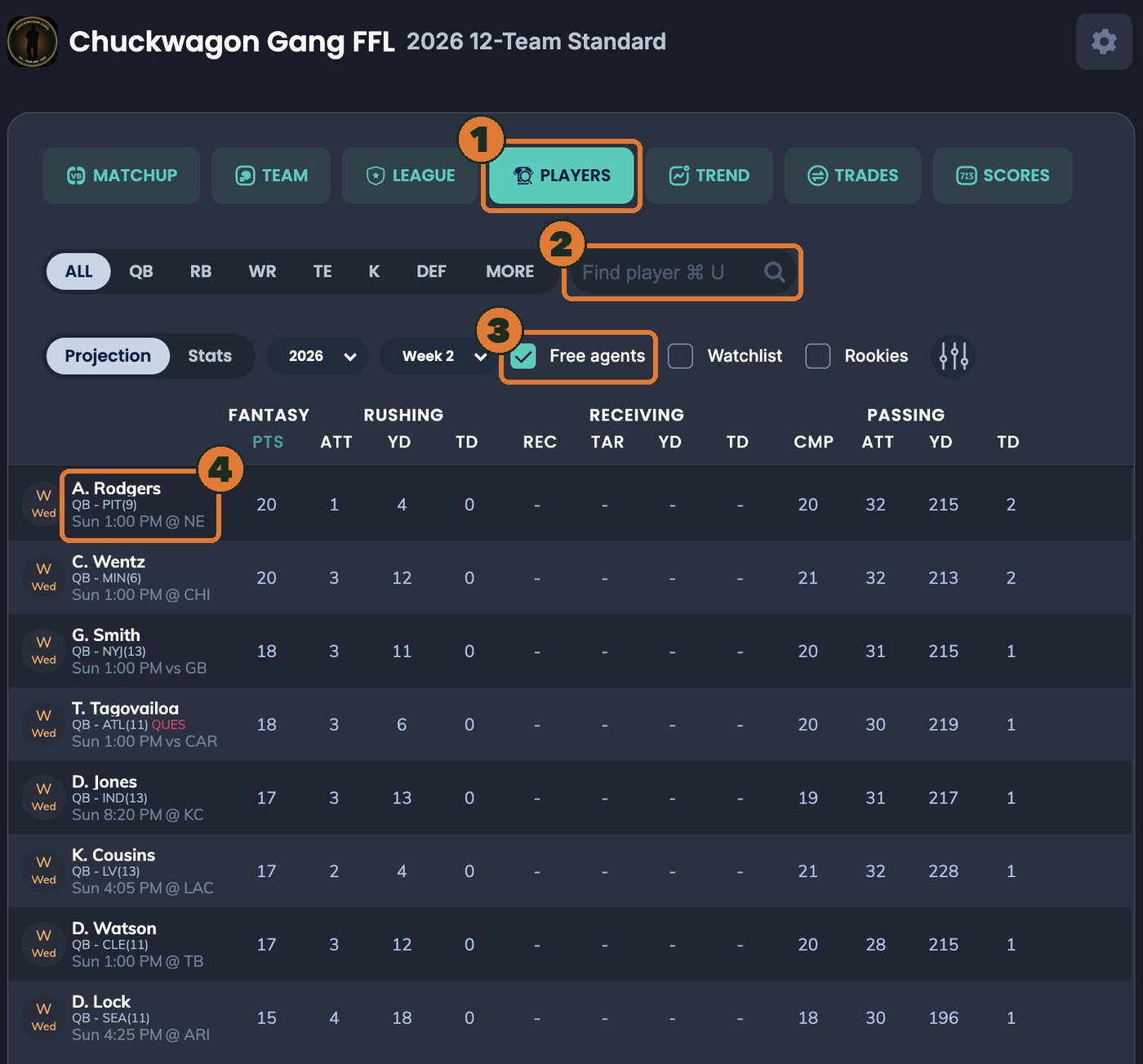
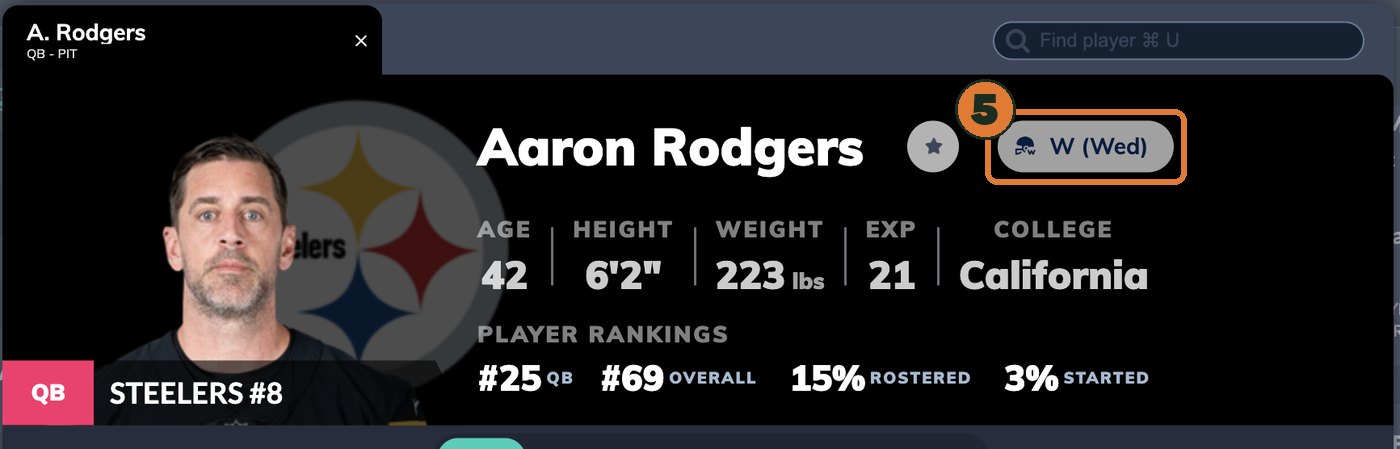
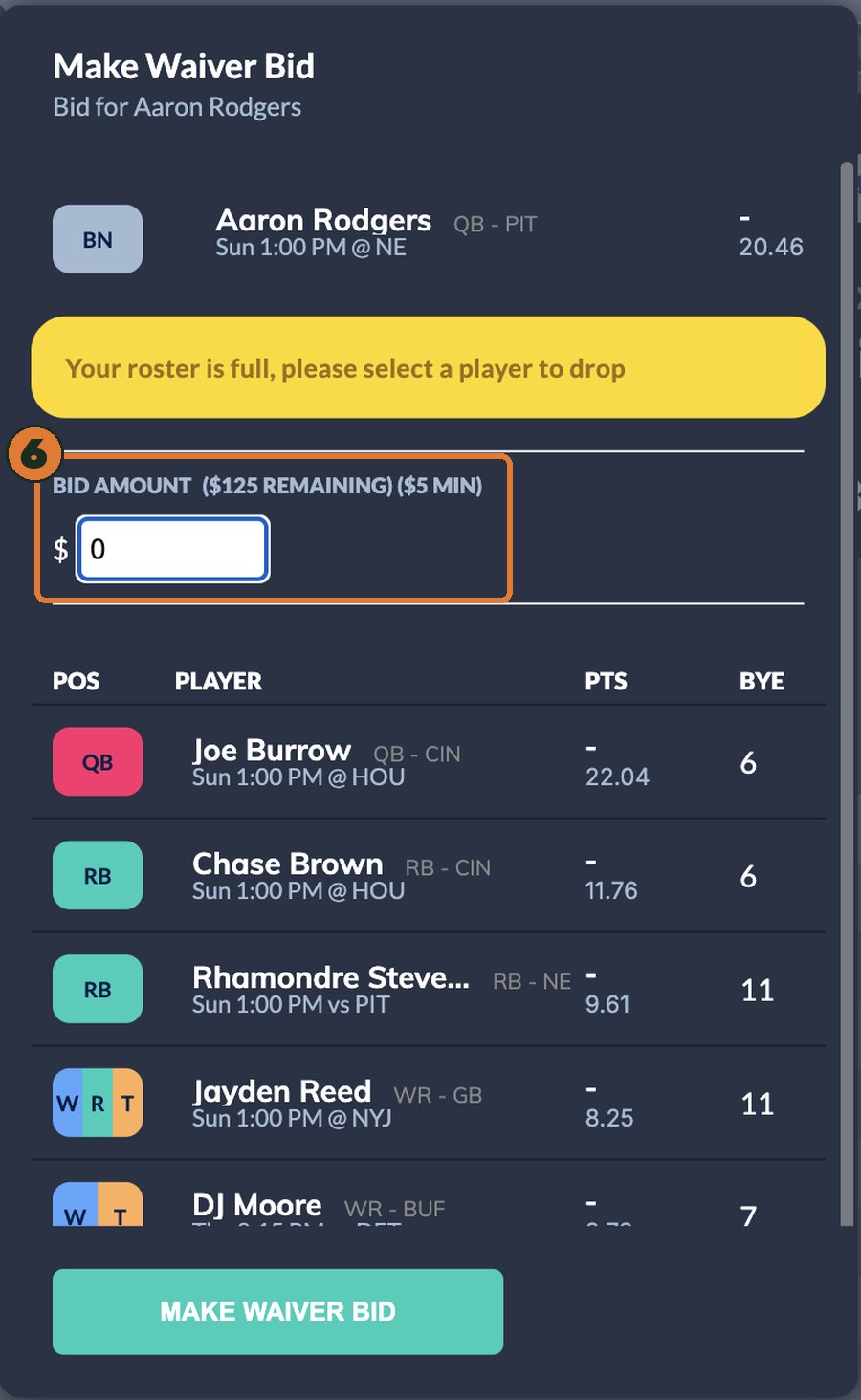
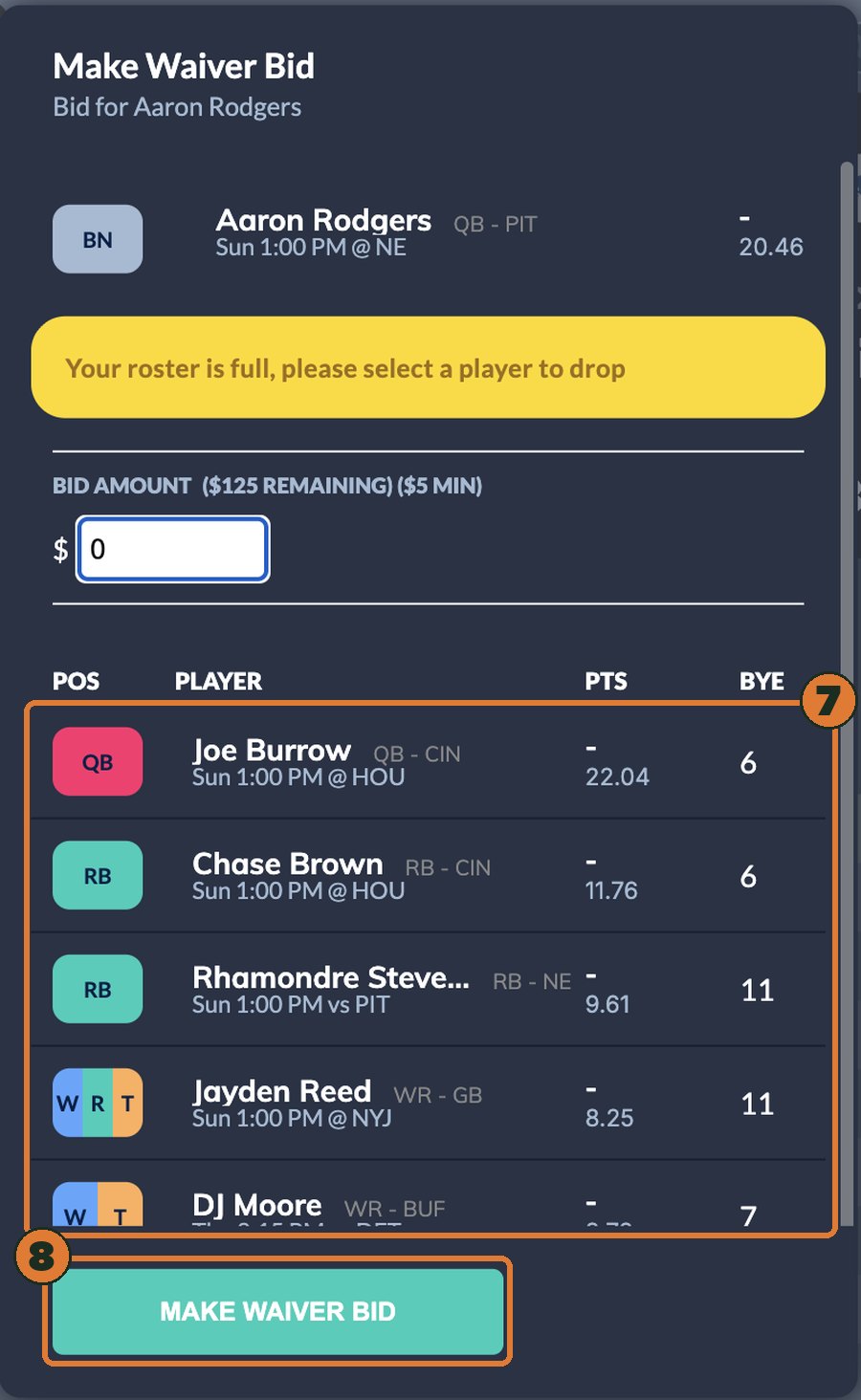
Trades are the one exception to all of the above. They are not bid on, they do not cost budget, and they are not limited to Wednesday and Saturday.
| Rule | Value | |
|---|---|---|
| Review window | 2 days | after both sides accept |
| Trade deadline | week 11 | nothing after that, all season |
| Draft pick trading | on | picks can be part of a deal |
If you get these right you know enough to draft well. Answers explain themselves as you go.